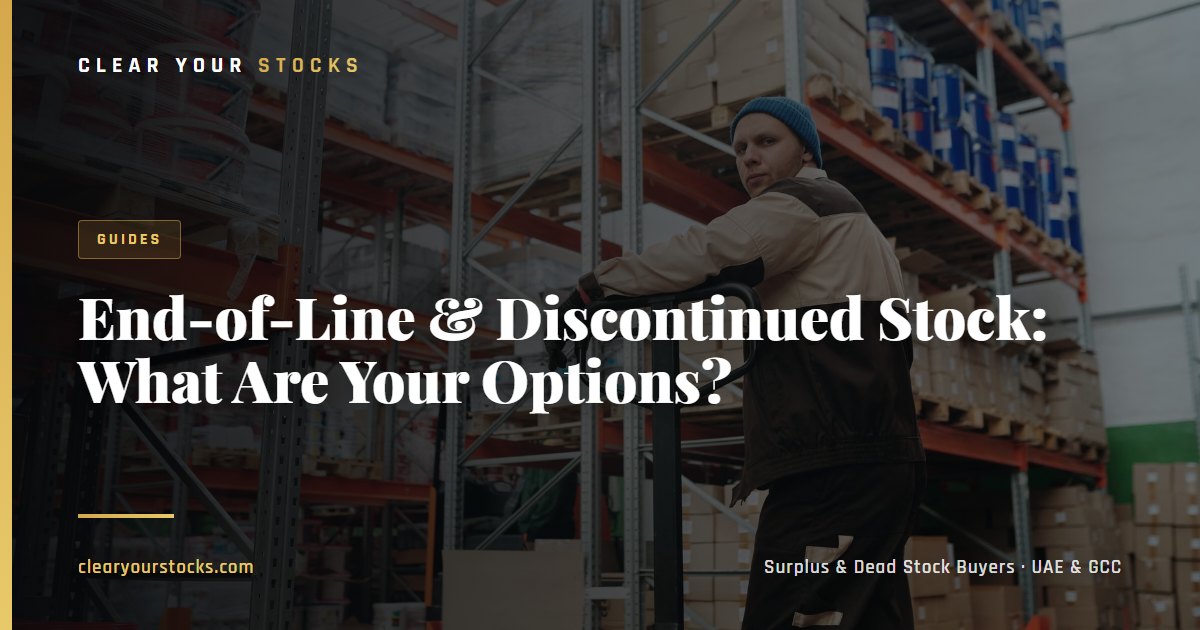
When a product line reaches the end of its life cycle, it ceases to be an asset and begins its transition into a liability. Every square metre in a Dubai or Jebel Ali warehouse is expensive; holding onto goods that no longer command full retail price is a direct tax on your profitability. Deciding how to sell discontinued stock is not just about clearing space; it is about recapturing working capital to reinvest in high-velocity products.
1. The Hidden Cost of Carrying End-of-Line Goods
Before choosing a disposal strategy, you must account for the carrying costs of your inventory. In the UAE, high humidity and temperature control requirements mean that electricity and facility maintenance costs are significant. If your discontinued items are sitting in a premium location, the opportunity cost of that space is often higher than the liquidation value of the goods themselves. You aren't just losing money on the unsold stock; you are losing money every day that stock blocks new, profitable inventory.
2. Option A: Markdown and Internal Clearance
The most common approach is aggressive discounting. While simple, it carries risks to your brand equity. If you sell a premium electronics brand at a 60% discount, you risk training your customer base to wait for sales.
The Pros and Cons:
- Pros: Maintains customer engagement, keeps warehouse traffic moving.
- Cons: Potential brand erosion, margin dilution, and the high cost of retail labour for processing discounts.
3. Option B: Strategic Bundling to Move Dead Stock
If you have discontinued accessories or slow-moving parts, bundle them with your flagship products. For example, a retailer selling discontinued smartphone cases might bundle them at zero cost with a new model release. This acts as a 'gift' to the customer, adding value without cutting the price of your core product. For more on this, read our guide on Dead Stock vs Slow-Moving vs Obsolete Inventory: How to Clear Each One.
4. Option C: Returning to Supplier
Check your original purchase agreements. Many suppliers offer 'buy-back' clauses or inventory rotation terms. While this is the cleanest route, it often involves restocking fees of 15-25%. If your supplier refuses, you are effectively forced to liquidate via other channels.
5. Option D: The Professional Liquidation Route
Working with a dedicated surplus buyer is often the fastest way to turn inventory into liquidity. Unlike selling on a public marketplace, a professional buyer like Clear Your Stocks takes the entire lot, provides a cash offer, and handles the logistics. This is crucial for businesses that need to clear large volumes of building materials or machinery immediately.
Scenario 1: Electronics Distributor
An electronics firm in Dubai had 500 units of a discontinued tablet model. Holding them was costing AED 4,000/month in climate-controlled storage. By engaging a bulk buyer, they cleared the lot in 48 hours for a lump sum of AED 150,000. While this was below the original retail value, the immediate influx of cash allowed them to secure a high-demand shipment for the upcoming season, turning a loss into a strategic advantage.
6. How Surplus Buyers Determine Value
Buyers don't just look at cost; they assess resale viability and logistics. You can learn more about this by reviewing 7 Factors Surplus Stock Buyers Use to Price Your Inventory. Factors include the market demand in export corridors, the condition of packaging, and the total SKU count.
7. Option E: Exporting and Secondary Markets
If your local market is saturated, the UAE serves as a world-class transit hub. Exporting discontinued stock to emerging markets in Africa or Central Asia can often yield a higher return than local deep-discounting. However, this requires expertise in logistics, customs, and international compliance, which is why most SMEs choose to sell to a specialist wholesaler who already has these distribution channels established.
8. Step-by-Step Decision Matrix
To determine your best move, follow this flow:
- Check Contract: Can the supplier take it back for a reasonable fee? If yes, do it.
- Analyze Velocity: Is it 'slow-moving' (selling at a trickle)? Try bundling.
- Assess Liquidity Needs: Do you need cash now? If yes, call a bulk buyer.
- Review Obsolescence: If the product is past its expiration or obsolete, engage a professional clearing house to avoid disposal fees.
Scenario 2: FMCG Overstock
A grocery supplier faced a 3-month expiry deadline on 2,000 units of premium detergent. Selling through retail would have taken 4 months. By selling the entire lot at a wholesale liquidation price, they recovered 40% of their investment instantly, avoiding the total write-off that would have occurred had the products expired on the shelf.
Conclusion
Discontinued stock is an inevitable byproduct of a healthy business. The key to maintaining high growth is managing the exit velocity of these items. Whether you choose internal markdown or bulk liquidation, the goal must remain the same: free up capital and space. If you are sitting on significant stock that is simply taking up warehouse rent, contact the team at Clear Your Stocks today for a professional, no-obligation valuation and rapid collection service.
Frequently Asked Questions
How quickly can Clear Your Stocks collect my goods?
We prioritise speed. Once we agree on a price, we typically arrange for collection within 24 to 48 hours, depending on the volume and location within the UAE.
What categories of stock do you purchase?
We buy across almost all sectors including electronics, garments, FMCG, cosmetics, hardware, machinery, and building materials. If it’s surplus or end-of-line, reach out.
Will selling to a liquidator damage my brand?
Not if done correctly. We ensure that your goods are moved to secondary or export markets, keeping them away from your primary retail channels and protecting your brand image.
Do I need to pack the items for collection?
We provide flexible solutions. In many cases, we handle the logistics and collection ourselves, provided the stock is palletised and accessible. We discuss all logistics details during the valuation process.