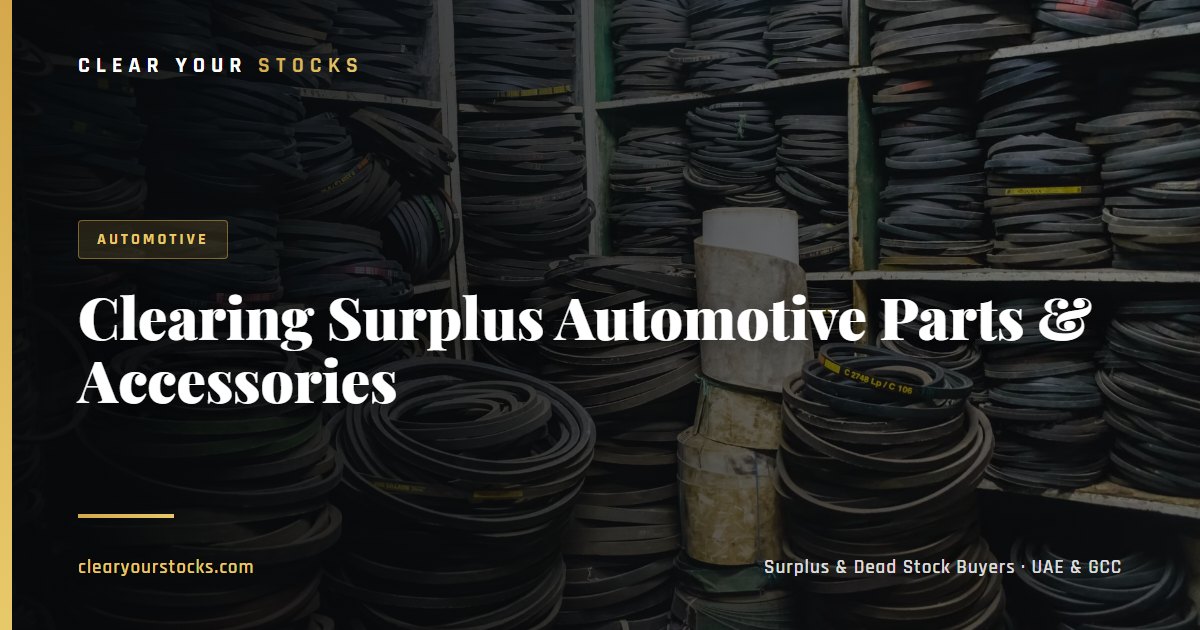
In the high-velocity automotive market of the UAE, where vehicle models evolve rapidly and specifications change annually, obsolescence is the silent killer of profitability. For garages, distributors, and parts traders, the decision to sell surplus auto parts is not merely a cleanup exercise—it is a critical financial strategy to free up warehouse space and reclaim working capital. Holding onto parts that haven't moved in 18 months isn't just taking up shelf space; it is a direct cost to your business in insurance, climate control, and opportunity cost.
Understanding the Lifecycle of Auto Inventory
Auto parts are uniquely vulnerable to depreciation. Unlike durable building materials, which might remain relevant for decades, a sensor, ECU, or exterior trim piece for a 2015 model often becomes 'dead' the moment the manufacturer shifts focus to a newer platform. Understanding this lifecycle is crucial before you attempt to liquidate your stock.
- New Old Stock (NOS): Original factory parts that are still in packaging but are no longer the 'current' model.
- Slow-moving stock: Items with a turn rate of less than once per year.
- Obsolete inventory: Items that have no market demand because the vehicle platforms they fit are no longer on the road in significant numbers.
If you find your shelves are increasingly occupied by these categories, it is time to reassess your strategy. For a more granular look at identifying these pain points, read our guide on 5 Signs Your Business Is Sitting on Dead Stock (and What to Do).
Factors That Affect Your Liquidation Offer
When you approach a buyer to liquidate automotive components, the offer price is determined by several specific variables. Buyers like Clear Your Stocks look at the 'recoverable value' rather than the original invoice price.
1. Packaging Integrity
An OEM part in a battered, oil-stained box loses significant value compared to one in original, pristine packaging. Even if the part itself is functional, the lack of original packaging makes it difficult to verify authenticity for future buyers.
2. Batch Homogeneity
Bulk buyers prefer consistent lots. A pallet of 500 identical oil filters is much easier to move than 500 individual parts from 200 different vehicle models. Homogeneity reduces sorting and verification costs, which translates to a higher offer for you.
3. Model Year Relevance
A set of brake pads for a 2023 SUV will always command a premium over pads for a 2010 sedan. Buyers must factor in the time and logistics involved in finding a home for the latter.
Scenario: The Impact of Inventory Clearing
Consider a scenario where a mid-sized Sharjah distributor holds 400 units of discontinued performance accessories. They have been sitting for three years, costing roughly 15 AED per unit per year in storage overhead. That is 18,000 AED in pure loss. By choosing to clear the stock at a wholesale rate of 60,000 AED, they not only recoup the cost of the goods but also immediately stop the 6,000 AED annual hemorrhage in carrying costs.
Categorising Your Surplus: What Can You Sell?
Not all surplus is created equal. Understanding the marketability of your items will help you negotiate a better deal. Generally, we see inventory falling into three tiers of liquidity:
- High Liquidity: Consumables like air filters, brake discs, spark plugs, and common suspension bushings for popular GCC car brands (Toyota, Nissan, Mitsubishi).
- Medium Liquidity: Exterior lighting, sensors, and interior trim pieces that are occasionally replaced due to accidents or wear.
- Low Liquidity (Specialised): Heavy machinery parts, engine internals for luxury vehicles, or niche performance tuning parts.
If you find that your surplus is mixed with other non-automotive items, such as Overstock Building Materials & Hardware, ensure you categorise them separately before requesting a quote, as these often have different secondary market channels.
The Logistics of Bulk Removal
One of the biggest hurdles to liquidating auto parts is the weight and logistical complexity of moving bulk quantities. Tyres, for instance, are notoriously difficult to transport due to their shape and volume. When dealing with liquidation, you need a partner who provides free collection to ensure the logistics costs don't eat into your recovery profit.
Step-by-Step: Preparing Your Inventory for Liquidation
To get the best possible offer, follow this structured process:
- Clean the Warehouse: Physically segregate the dead stock from your active, fast-moving items.
- Inventory Audit: Create a manifest including: Part Number, Brand, Quantity, and current condition of the packaging.
- Photo Evidence: Take clear, high-resolution photos of the inventory in situ. Include close-ups of any labels or part numbers.
- Valuation Check: Research the current market price for these items, but be realistic—liquidation buyers buy at wholesale for volume, not retail.
- Contact a Bulk Buyer: Reach out to a professional liquidator like Clear Your Stocks. Provide your manifest and photos for a rapid, no-obligation valuation.
Why Professional Liquidation Beats In-House Clearing
Attempting to sell parts one by one via online marketplaces is a recipe for operational failure. The time spent dealing with 'tyre-kickers,' managing individual shipping labels, and handling customer service inquiries will far exceed the profit margin of the parts themselves. By selling in bulk, you convert a 12-month headache into a same-day financial settlement. This approach is similar to why businesses choose to move bulk inventory for other categories, as discussed in our Year-End Inventory Clearance: A Checklist for UAE Businesses.
Conclusion: Stop Stagnation, Start Scaling
Your capital is meant to be in motion. Every dirham tied up in a dusty box of auto parts is a dirham that isn't being used to purchase trending stock or improve your service centre’s capabilities. By auditing your inventory, categorising your surplus, and engaging with a professional bulk buyer, you turn a dormant liability into a cash injection. If you are ready to reclaim your warehouse space, contact Clear Your Stocks today for a professional evaluation. We pay fast, collect for free, and handle the entire liquidation process with minimal disruption to your operations.
Frequently Asked Questions
Do you buy used or damaged auto parts?
We primarily focus on brand new, surplus, or factory-excess inventory in original packaging. We do not generally purchase used, salvaged, or damaged parts that require refurbishment.
How quickly can you collect the stock?
Once an offer is accepted and the inventory is confirmed, we can often schedule collection within 24 to 48 hours, depending on your location in the UAE.
Do I need to organise the transport for the surplus parts?
No. One of the main benefits of working with Clear Your Stocks is our end-to-end service. We provide free collection, meaning our team handles the loading and logistics, saving you the hassle and cost of transport.
What information do you need to give me a price?
To provide an accurate offer, we require a clear manifest (Excel or CSV) including part numbers, brand names, quantities, and high-quality photos of the inventory, including the condition of the original packaging.